Yamazo Academy: lean manufacturing from first steps to specialist

From value and waste to time study, from line balancing to production planning, quality and hoshin kanri: what the shop floor and its managers need, in order and with real numbers. The path ends with the Lean Manufacturing Specialist certificate.

modules
32
lessons
159
hours of study
192
languages, free
3
The curriculum as a Yamazumi chart. Each column is a module, each block a lesson; the height of a block is the length of the lesson.

1.1, 12 min, Open to everyone

What is value in lean? From customer needs to work steps

  1. 1

    Read

    Open to everyone

    All of Module 1 is open. Every other lesson also has an open section with its definition, why it matters and its formula.

  2. 2

    Apply

    Approved Academy account

    Access the rest of each lesson: step-by-step instructions, a worked example with real numbers and common mistakes.

  3. 3

    Test yourself

    Yamazo One and partners

    End-of-lesson quizzes, exercises, cases and labs. Your account saves your progress and where you left off.

  4. 4

    Get certified

    License holders and partners

    Take a theory exam and a practical exam. Prove you can do the work correctly, rather than just confirm you watched a video.

Curriculum

Each module builds on the last. The icons beside each lesson link to its glossary page and calculator.

Module 1: Value and shop-floor observation

Participants separate observation from interpretation, measure losses without double counting and select a safe improvement trial.

5 lessons, 60 min
Fully open
  1. 1.1What is value in lean? From customer needs to work steps12′
  2. 1.2The 8 wastes of lean: how to spot waste in manufacturing12′
  3. 1.3Value-added vs non-value-added activities: how to classify time12′
  4. 1.4How to do a gemba walk: from observation to verified action12′
  5. 1.5How to implement 5S: steps to organize and maintain a workplace12′
Module 4: Work sampling and choosing a measurement method

The learner separates estimating a proportion from measuring a duration, chooses the observation plan that fits the question, and checks the integrity of the data.

5 lessons, 60 min
  1. 4.1Work sampling: activity classes and a random observation plan12′
  2. 4.2Confidence intervals, sample size and bias in work sampling12′
  3. 4.3Predetermined time systems: logic and limits of use12′
  4. 4.4Integrity and missing records in observation data12′
  5. 4.5Choosing the measurement method that fits the job12′

Module 5: Yamazumi and line balancing

Read workloads and move from the lower bound on operator count to two feasible task allocations that meet precedence, equipment and competency constraints.

5 lessons, 60 min
  1. 5.1How to read a Yamazumi chart: workload and takt time12′
  2. 5.2Line balancing: calculate the number of operators12′
  3. 5.3Precedence constraints in assembly line balancing12′
  4. 5.4Mixed-model line balancing: calculations and example12′
  5. 5.5Precedence diagram, positional weight and line efficiency12′

Module 6: Standard work

You can combine the work sequence, required work in progress and simultaneous human–machine work in a safe arrangement and verify it after changes.

5 lessons, 60 min
  1. 6.1Elements of standard work: takt time, sequence and WIP12′
  2. 6.2Standard work combination sheet: how to create one12′
  3. 6.3Man-machine chart: work, waiting and machine allocation12′
  4. 6.4Standard work revision, training and method verification12′
  5. 6.5Visual standard work and abnormality: detecting deviations12′

Module 8: Value stream and product family

To choose a workable flow boundary by calculating information, material, waiting and transport load within the same product family and time limit.

5 lessons, 60 min
  1. 8.1How to draw a current state value stream map12′
  2. 8.2Process cycle efficiency (PCE): formula and calculation12′
  3. 8.3Future state value stream map: flow, pull and kanban12′
  4. 8.4Spaghetti diagram and transport load: measuring the current path12′
  5. 8.5How to set the product family and value stream boundaries12′

Module 11: Quality and stability

You can make an evidence-based quality decision by calculating measurement consistency, process stability, capability and the source burden of nonconforming product separately.

5 lessons, 60 min
  1. 11.1Observer-to-observer consistency in a time study12′
  2. 11.2Statistical process control: time order and special causes12′
  3. 11.3Process capability: stability, distribution and limits12′
  4. 11.4First-pass yield and the capacity effect of rework12′
  5. 11.5Quality at the source and segregating nonconforming product12′

Module 12: Evidence-based problem solving

The learner tests cause assumptions with comparable data and decides on an improvement by separating its effect on capacity, expense and cash.

5 lessons, 60 min
  1. 12.1Kaizen and PDCA: continuous improvement on the shop floor12′
  2. 12.25 Whys root cause analysis: steps and an example12′
  3. 12.3A3 problem solving: how to write an A3 report12′
  4. 12.4Calculating improvement savings, ROI and payback period12′
  5. 12.5Testing root cause hypotheses and verifying the result12′

Module 15: In-plant logistics and line-side supply

Size the safe transport route, the container quantity, the replenishment frequency and the line-side stock together, and test vehicle and driver suitability.

6 lessons, 72 min
  1. 15.1Plan for Every Part: Container, Address, Frequency and Source12′
  2. 15.2Milk Run Route and Replenishment Frequency12′
  3. 15.3Line-Side Stock and Container Sizing12′
  4. 15.4Vehicle Need and Transport Cycle12′
  5. 15.5Picking Layout and Material Presentation12′
  6. 15.6Safe and Traceable Flow from Warehouse to Line12′

Module 18: Reliability and maintenance

By relating failure frequency, repair and waiting times, task authority and planned maintenance load to flow, you can make safe maintenance decisions.

5 lessons, 60 min
  1. 18.1Equipment Criticality Analysis and Maintenance Priority12′
  2. 18.2Autonomous Maintenance Steps and Authority Limits12′
  3. 18.3Time Between Failures, Repair Time and Availability12′
  4. 18.4Planned Maintenance, Spare Parts and Work Orders12′
  5. 18.5The Maintenance–Flow Relationship and Condition-Based Intervention12′

Module 22: Makigami and administrative flow

The participant maps the information and role flow of administrative requests, measures processing and waiting, calculates returns and open work, and designs a future state that keeps the necessary authority.

5 lessons, 60 min
  1. 22.1Setting the Boundary of an Administrative Process with Makigami12′
  2. 22.2Active Processing and Waiting Time in the Office12′
  3. 22.3Handoffs, Rework and First-Time-Right12′
  4. 22.4Pull and Open-Work Limits in Administrative Work12′
  5. 22.5Administrative Future State and Service Design12′

Certification: show you can do the work

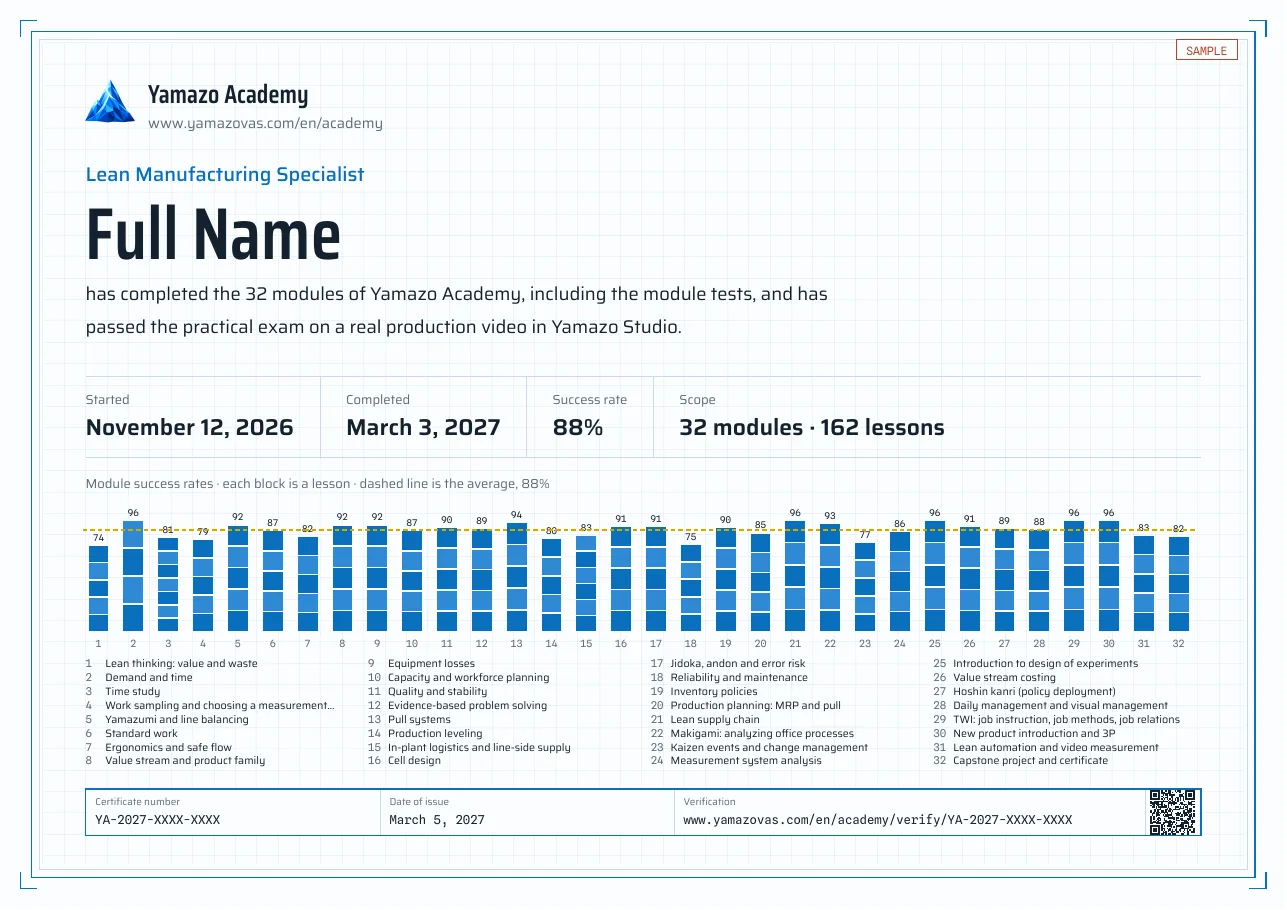
Certification requires two exams. The theory exam tests concepts and calculations. In the practical exam, you receive a time study video we have recorded. Break the work into elements, measure the times, and build a Yamazumi chart. You receive a certificate if your result falls within the acceptance range.

The five labs and the practical exam are done in the free academy mode of Yamazo Studio and are required for the certificate. Install Studio on a Windows or macOS computer and sign in with your academy account on the license screen; no license key is needed. Lessons and quizzes stay in the browser.

Each certificate has a number. An employer or customer can use it to verify the certificate on the website.

The certification exam is included with a Yamazo One license and is free for partners. It is not sold separately.

Sample certificate: name, start and finish dates, success rate, a Yamazumi chart of the modules, certificate number and verification QR code
VisitorAcademy account (free)Yamazo One or partner
All of Module 1
Definition and formula for every lesson
Full lessons: steps, worked example, mistakes–
Quizzes, exercises and cases, progress––
Labs and the practical exam––
Certification exam––

Frequently asked questions

Can I learn without using Yamazo?
Yes. The lessons explain the method. You can do every calculation by hand or with the free calculators on the website. Yamazo simply makes the practical work easier.
Does the Academy cost anything?
Reading the lessons is free. Quizzes, exercises, labs and the certification exam are open to staff of companies with a Yamazo One license and to Yamazo partners. An Academy account is opened with a work email address and can be used once it is approved; personal and temporary email addresses are not accepted.
Who can take the certification exam?
Users with a Yamazo One license and Yamazo partners. The exam is included with the license and is not sold separately.